The Race That Never Happened: My Coach, His Mini, and 1.142 Seconds
Jul 12, 2026
The Race That Never Happened
AI-coached track weekends · Road Atlanta, July 2026. Rich — the coach from the Barber post — is back, and this time he brought his own car.
Same weekend: Two Z4s, One AI Race Engineer · The Mini Out-Cornered My M40i · Fourteen Years, Eight and a Half Seconds
Road Atlanta. Two and a half miles. In the green corner: Rich's 2011 Mini Cooper S — full race prep, 2,350 pounds, driven by a career coach. In the blue corner: my bone-stock BMW Z4 Coupe — more power, more weight, softer springs, and a driver who'd never raced this car anywhere.
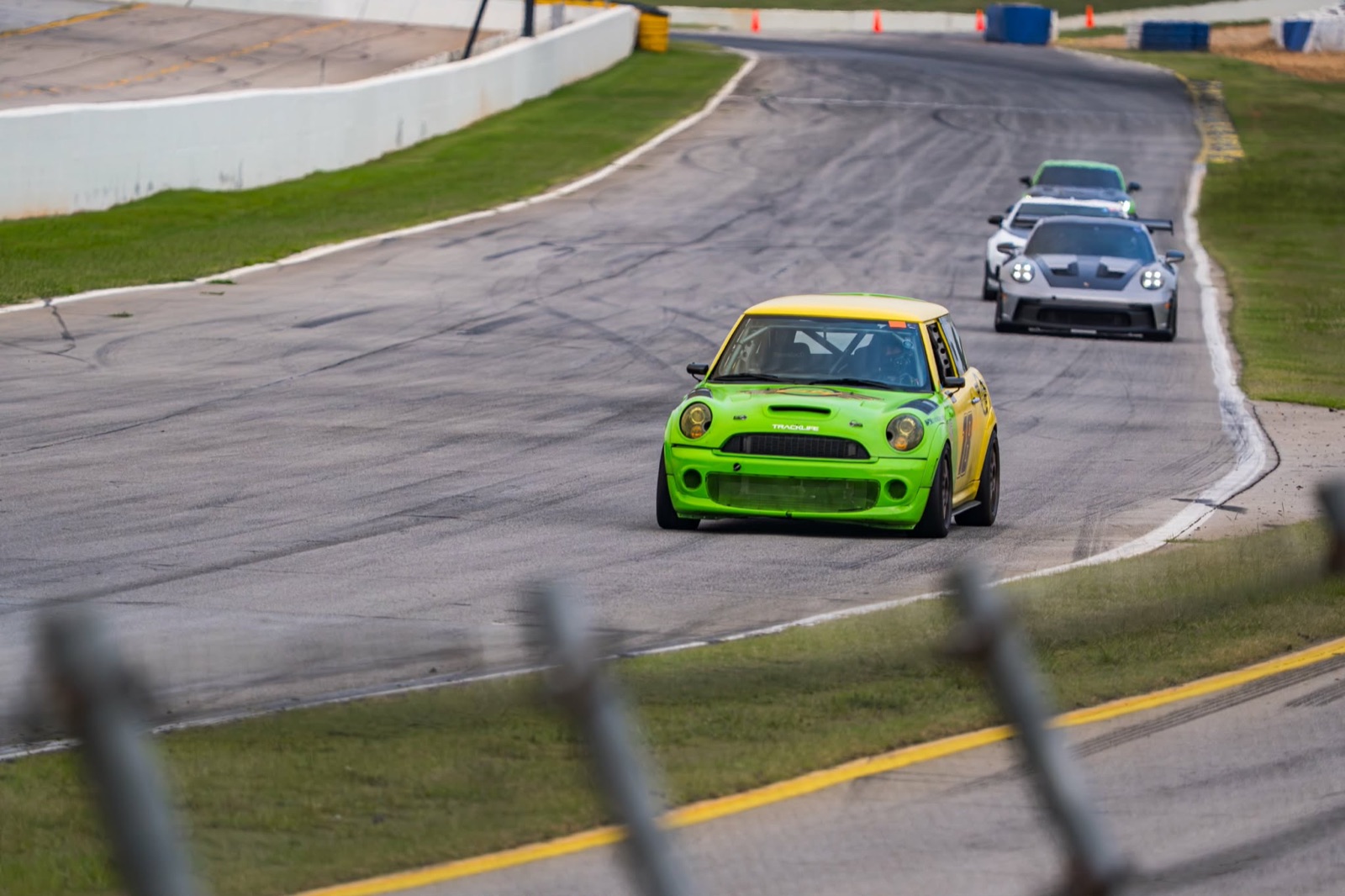 The #18 Mini, doing to a GT3 RS what it's about to do to me.
Green flag.
Start/finish. They cross the line together, and the first surprise is immediate: the Mini is faster across the stripe — 103 mph to the Z4's 97 — still carrying its exit off Turn 12. But the front straight climbs, the inline-six inhales, and by the Turn 1 braking marker the Z4 has clawed back three tenths on pure motor.
Turn 1. Then the corner arrives and the whole premise of this race introduces itself. The Z4 slows to 66 mph for the uphill right-hander. The Mini goes through at 80 — fourteen miles an hour more, through the same piece of asphalt — and takes back over half a second in one corner. It doesn't read like two lines through T1; it reads like one car turning in and one car simply continuing.
The Esses. Conventional wisdom says the light car owns the Esses. Not today. Both cars post nearly identical minimums through the first dip — 56 and change — but the Z4 out-accelerates the Mini between the bends and takes back 0.29, stretching its lead to +0.33, the best it will look all race. Through the second dip the pendulum swings again: the Mini carries 65 mph to the Z4's 62, the lead changes hands at the Esses exit, and it starts to build — half a second by Turn 5, nine tenths by the top of the hill.
Turn 7 — "the hole," the slowest corner on the track. Watch the approach: the Z4 brakes later and later, looming — and then the corner itself happens and the Mini is gone again. Minimum speed tells the story in one line: Rich carries 47.0 mph through the tightest point of Road Atlanta; I manage 44.6. In the car with less power, less tire, and nothing to bail him out on the following straight, he commits 2.4 mph harder than I do. That's not the car. That's the driver. By the crest the Mini's lead peaks at 1.32 seconds — the biggest gap either car sees all lap.
The back straight. And now it's the Z4's turn to remind everyone what displacement is for. Mid-straight the speed gap is absurd — 129.4 mph plays 112.4 — seventeen miles an hour of inline-six, and the lead collapses: 1.32 becomes 0.87, becomes 0.51. Into the braking zone for the Turn 10a/b chicane the Z4 carries its speed so much deeper that, on paper, it sweeps past into a 1.2-second lead. For about a hundred meters of braking zone, the heavier car has stolen the race back.
The chicane. Then everyone actually has to turn. Even here, at the end of the straight that is supposed to be all Z4, the Mini's minimum is 49 mph to the Z4's 45 — it rotates through 10a/b the way 2,350 pounds rotates, and is back in front within 200 meters.
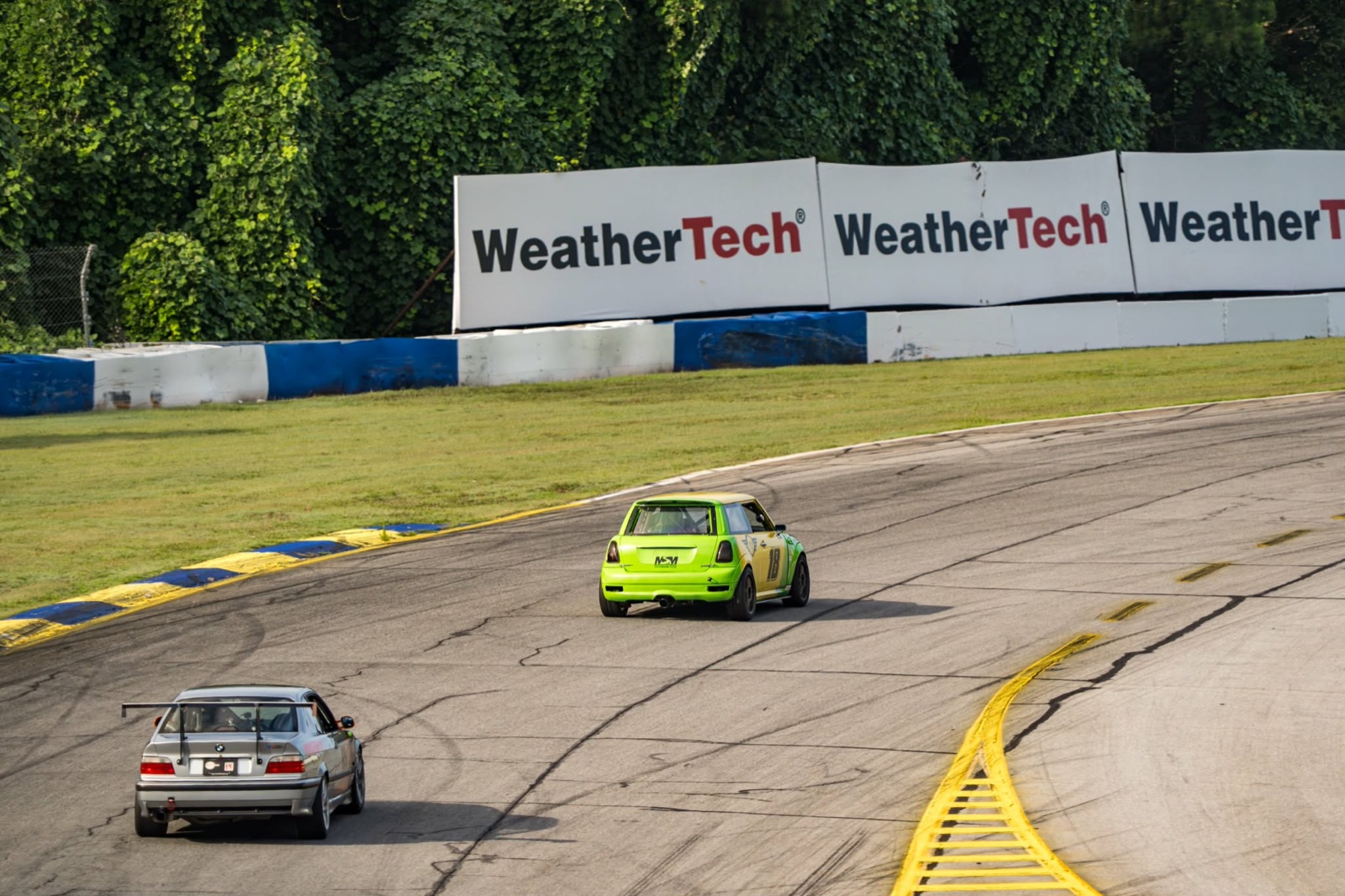 Corner exit is where the Mini does its accounting.
The climb to the bridge. Out of the chicane the track powers uphill, under the bridge toward Turn 12 — on paper, Z4 real estate. Except the horsepower never gets its chance, and the data can say exactly why: my own RPM trace. The Mini leaves the chicane 11 mph faster (66 to 55), and the Z4 comes off the corner in third gear at 4,439 rpm — a full gear conservative, thousands of revs below where the inline-six makes its power. No downshift to second for the chicane, an early upshift to fourth before the Turn 12 turn-in. That's not the car being slow; that's a driver three weekends into learning rev-matching, choosing to be safe instead of sorry on a downhill braking zone. The six trundles up its own favorite hill at half song, and the Mini — already ahead — stays there.
Turn 12. The knockout. Through the downhill right onto the front straight, the Mini's minimum is 82 mph to the Z4's 69 — thirteen miles an hour at the corner that feeds the longest full-throttle stretch on the track. The Z4 will spend the whole front straight paying for that corner and run out of room: 105 mph to 96 at the flag, the gap stretching every meter down the hill.
Checkered flag: Mini by 1.142 seconds. Six lead changes. The car with 9.6 mph less top speed wins the lap — and now you know exactly how: the Z4 wins every acceleration zone on the circuit, and the Mini wins almost every corner, by more.
Where 1.142 seconds actually lives
Split the lap in thirds and the whole story is one sector:
| Sector | What it is | Who gains |
|---|---|---|
| Sector 1 | Start through the Esses | Mini by 0.16s |
| Sector 2 | Turn 5 through the hole to the back straight | Mini by 1.08s |
| Sector 3 | Back straight, chicane, Turn 12 | Z4 by 0.10s |
Everything the Z4 wins, it wins with the throttle. Everything the Mini wins, it wins in the parts of the track where a coach spends his life telling students the lap time actually lives. Sector 2 is the coaching sector — no straight long enough to hide on, nothing but commitment and line. Rich's entire margin comes from there.
And one more compliment from the data: the spread across his five best laps was 1.3 seconds; mine was 2.1 — and his best lap of the weekend was his final flying lap, still improving when he took the checker. His was a metronome finishing a crescendo. There's a reason this man coaches.
Want proof? While this post was in draft, Rich watched the onboard video of my fast lap — no data, no gap curve, just coach eyes: "Cheating 6 and 7 horribly, too early. T1, look scared. And cheating 12 a bit too. Car looks good otherwise — brakes and tires doing their jobs. Entrance to the Esses you're having the lift, but suspension will fix that." Now line his eyes up against the math. "T1, look scared": 66 mph to his 80. "Cheating 6 and 7": the hole, 44.6 to his 47.0. "Cheating 12": 69 to his 82. Four corners called from a video with no numbers on the screen — the same four corners the gap curve had already flagged. The Barber post was about a human coach and the AI independently finding the same three corners at Barber. One series later, with a different car and a different track, the loop closes again.
Now, the confession
None of that happened.
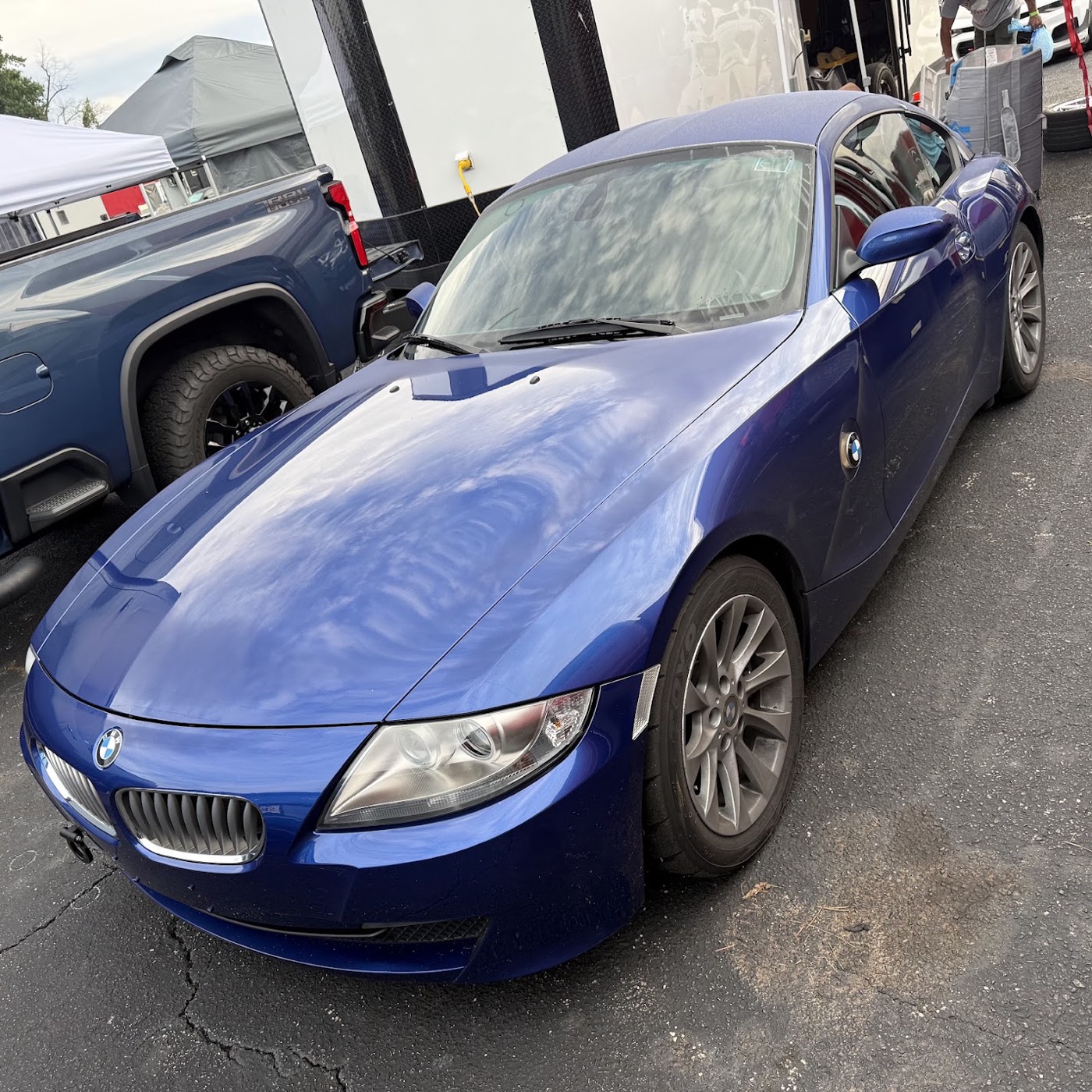 The blue corner, at rest. Bone stock, fresh R888Rs, zero track days on the
clock — until this weekend.
The blue corner, at rest. Bone stock, fresh R888Rs, zero track days on the
clock — until this weekend.
We were never on the same piece of track when it counted. This is HPDE — we don't race, officially. Rich's best lap went down at 10:11 on Sunday morning; mine came at 3:48 that afternoon. Five and a half hours apart, same track, same day. What you just read is a virtual race: both laps recorded as dense GPS — his AiM logging ten times a second, my Harry's LapTimer rig at twenty-five — aligned meter by meter and replayed side by side, like the Lando-versus-Max battles YouTube builds from real F1 telemetry. Every number in the broadcast is real. Only the wheel-to-wheel is simulated. (And the math checks itself: the virtual margin has to land exactly on the real lap-time gap, 107.848 versus 108.990. It does.)
Here's the thing about HPDE, though. A few times a year you find a car you can't catch but can't lose, and for twenty minutes it's the most honest driving you'll do all season. You still need to earn the pass — even if you're a little faster, you have to get there first, and then you need the point-by. Rich and I never found that moment on Sunday.
Saturday morning is another story.
The session that actually happened
While fact-checking this post, the AI cross-referenced our lap timestamps against the weekend schedule and confirmed it: Saturday morning, 8:30 Intermediate 2 — we were both in it. My E86's entire first stint sits inside his logger's recording window — the first laps I ever turned in this car, with the coach from the Barber post circulating on the same two and a half miles.
And when Rich read the draft of this post, he filled in the scene my memory had completely dropped: he passed me out there. The full picture, per Rich: that first session was a classic Saturday-morning Int-2 train — everybody rolling out together into one giant bee swarm. He started five to eight cars behind me and spent his opening laps carving through the queue while I sat mid-swarm with my left arm on constant point-by duty. When he finally reached my bumper, I gave him — his words — "a nice clean point-by ... finally." Afterward he found me in the paddock to ask how the car was and whether I was having trouble with my mirrors, because that left arm had looked busy. I heard it as a dig and said "just traffic." It wasn't a dig — it was a coach noticing a driver juggling a brand-new car, unfamiliar mirrors, two students, and a wife arriving mid-morning. He'd even wondered, out on track, whether I'd have been better served pulling off down the back straight to release the whole train at once. He's probably right. Evidently I wanted to marinate in the bee swarm.
So we went and got the Saturday data. And there it is, GPS trace against GPS trace, timestamped to the tenth of a second:
8:34:19 AM. Four minutes into my first-ever session in this car, the Mini shows up in the data 250 meters behind me and starts closing — not a clean chase, but a carve, working through the cars between us one point-by at a time: 200 meters, 120, 80, 50. ("I held you up for four minutes," I told him. Four minutes to clear a Saturday-morning train, in traffic, on cold tires — I'll call that even.) 8:38:10 — the gap reads zero. Side by side on the run down from the bridge into Turn 11 — both cars accelerating, me 69 mph, him 76. Five seconds later he's ahead through Turn 12. Fifteen seconds later he's 54 meters up the road and gone. My speed trace never lifts — 69 to 77 mph straight through the pass — the GPS signature of exactly what Rich remembered: a clean rolling point-by, given where an instructor gives one, on the downhill run to the front straight, so nobody's bottled up somewhere you can't pass.
And then, while writing the next post in this series, I went looking for this exact moment in my in-car video. It's better than the data described:
Lap 2 of my first-ever session in the E86: the #18 Mini appears alongside under the bridge at Turn 11 and is gone by Turn 12 — 21 seconds, corner speeds on the overlay, exactly where the GPS said it happened. (The earlier version of this post put the pass at Turn 3, off the GPS trace alone — the video says Turn 11, and the video wins.)
The "traffic" I remembered? Real — the whole swarm of it. But the overlay is clear about how the story ends: for the last four minutes of it, the traffic was me. The race that never happened turns out to have had an opening move after all — a real pass, at a real corner, at 8:38 on a Saturday morning — and the database (and, it turns out, the dashcam) had it the whole time.
How this post exists (the nerd part — skippable)
After the weekend, Rich sent me a zip of his lap data. One problem: his AiM Solo logs in Race Studio's binary format, and trackdays.ai spoke Harry's LapTimer, Porsche PTPA, and RaceBox. The site's upload pitch had been promising "AiM" support on faith — Rich was the first person to call the bluff. So this became the beta test. One evening with the AI doing the heavy lifting: a new AiM parser (which taught us that Race Studio exports are Latin-1 encoded, restart their clocks at every beacon, and log speed in whatever unit they feel like), a schema migration, zip and Dropbox-link handling for email attachments, and a driver record with his blessing: Rich S., 2011 MINI Cooper S, live on the site. Driver number seven in the database — but the first AiM logger, and the first virtual race.
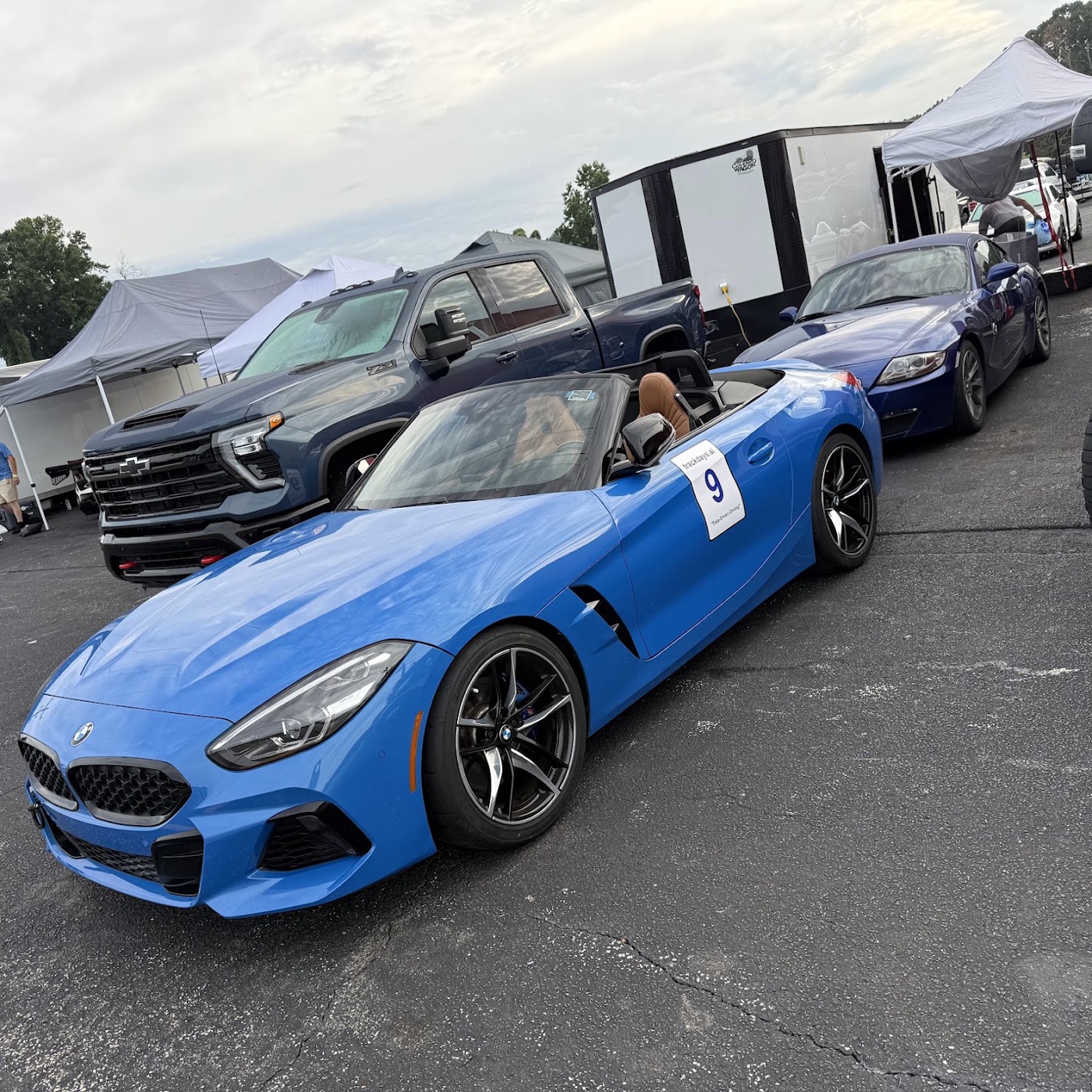 The two-Z4 weekend: the modern M40i and the E86, sharing a paddock spot
and a driver.
The two-Z4 weekend: the modern M40i and the E86, sharing a paddock spot
and a driver.
Full disclosure on the matchup, because the spec sheet undersells how lopsided it was in both directions. My car: an E86 Z4 Coupe, 100% stock — not even the sport package, original springs fresh at 36,000 miles. What it did have: brand-new Toyo R888Rs, fresh rotors, DTC-60 pads. Real rubber, real brakes, sofa suspension.
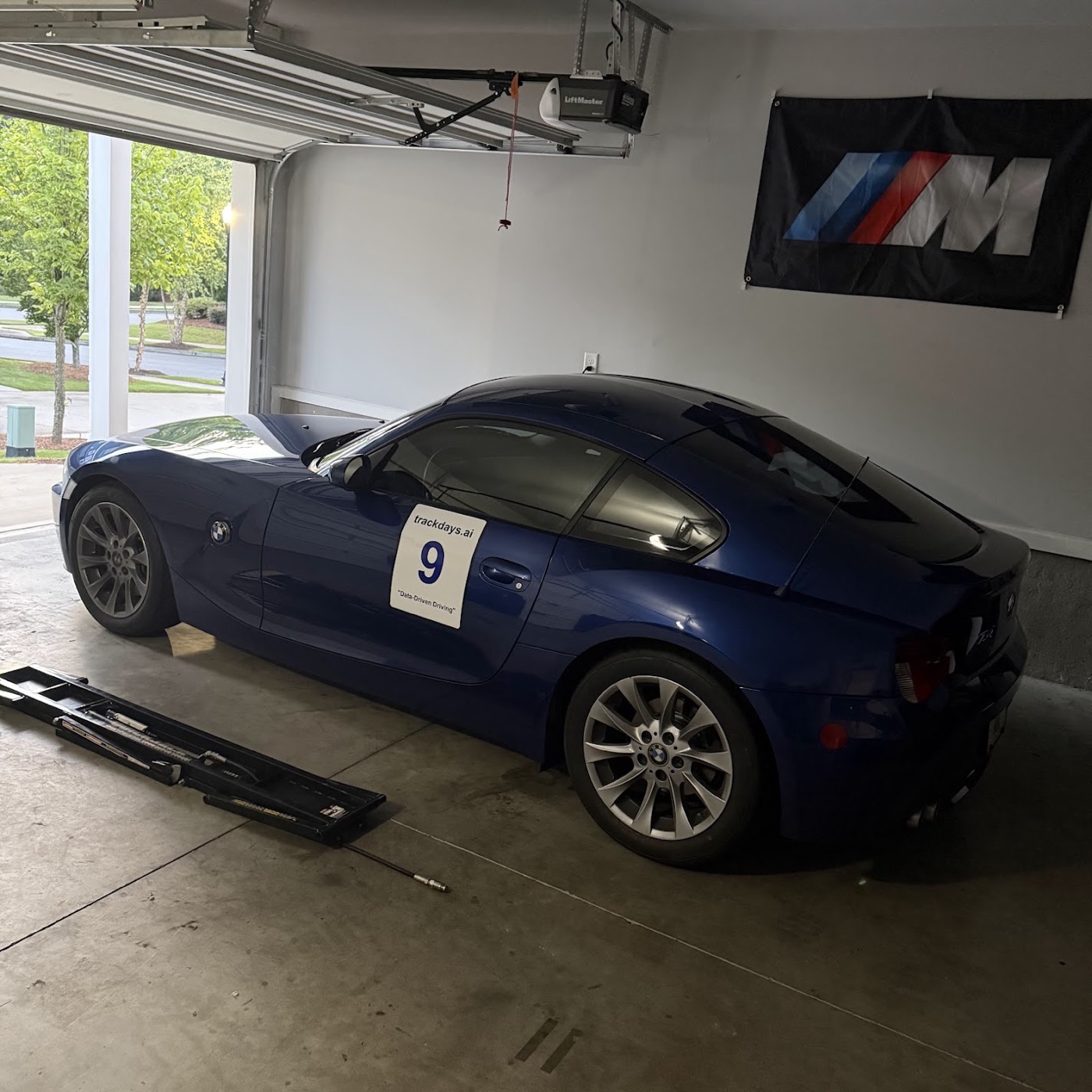 Number 9 assigned, M flag supervising. My hands: this was the first time I had
ever driven this car on track, it's a manual, my last stick-shift track
car was my old 328i years ago, and I'd started seriously learning to
rev-match a few weeks before the event. Rich, meanwhile, brought years of
coaching craft — though, as he pointed out reviewing this post, it was a
weekend of firsts for him too: his first time bringing the Mini to Road
Atlanta (he'd run RA before in other machinery, including a ChampCar
endurance racer — the track was wired, the car was new). The learning curve
is right there in my data: the E86 went 1:50.10 Saturday to 1:48.99 Sunday
and was still finding time when the weekend ended — the shape of a novice's
progression, because in this car that's functionally what I am. A few mods
and a few hundred heel-toe reps from now, this soft, stock coupe is going
to be a weapon. One step at a time.
Number 9 assigned, M flag supervising. My hands: this was the first time I had
ever driven this car on track, it's a manual, my last stick-shift track
car was my old 328i years ago, and I'd started seriously learning to
rev-match a few weeks before the event. Rich, meanwhile, brought years of
coaching craft — though, as he pointed out reviewing this post, it was a
weekend of firsts for him too: his first time bringing the Mini to Road
Atlanta (he'd run RA before in other machinery, including a ChampCar
endurance racer — the track was wired, the car was new). The learning curve
is right there in my data: the E86 went 1:50.10 Saturday to 1:48.99 Sunday
and was still finding time when the weekend ended — the shape of a novice's
progression, because in this car that's functionally what I am. A few mods
and a few hundred heel-toe reps from now, this soft, stock coupe is going
to be a weapon. One step at a time.
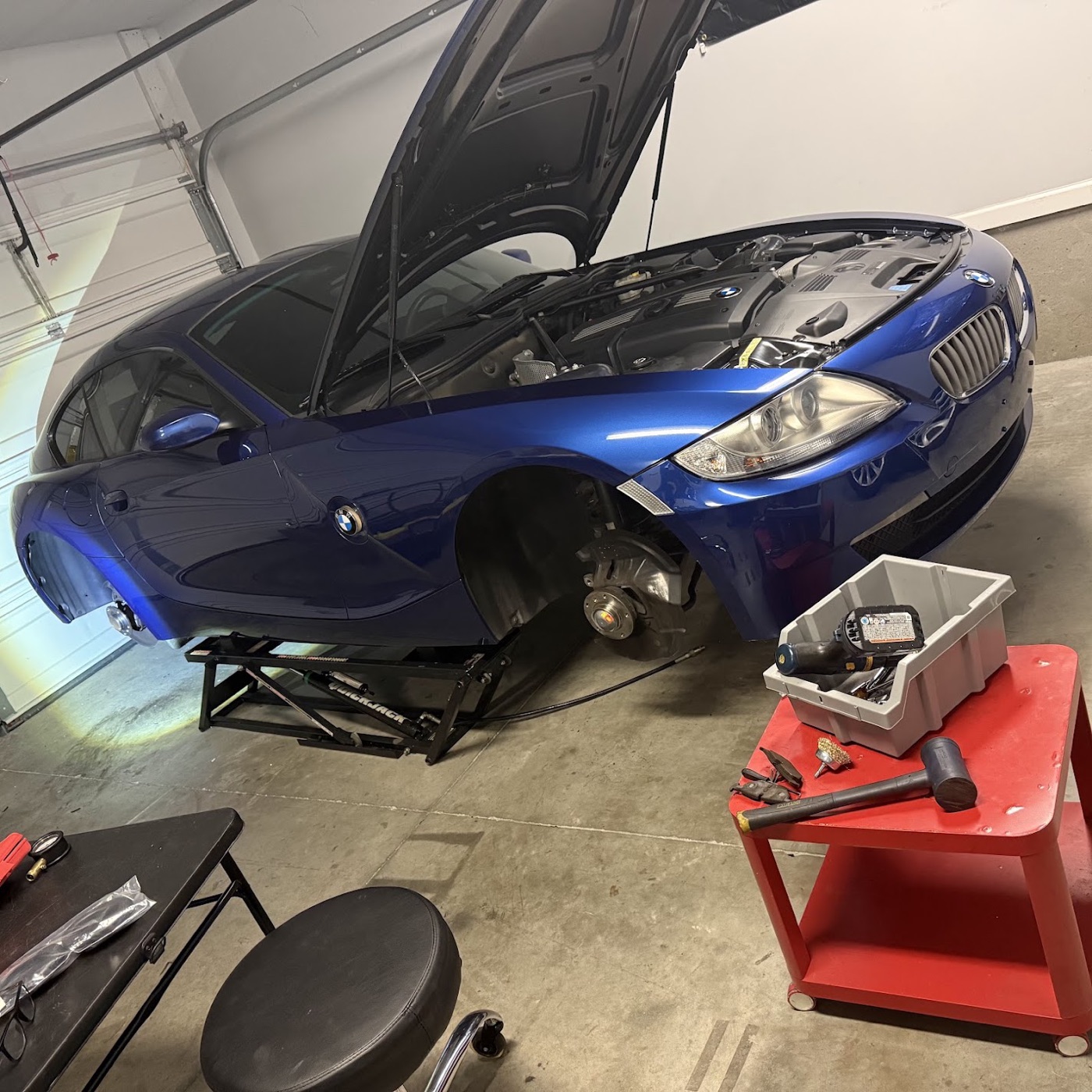 Seven days before the event. The bleeder-valve saga of how two Z4s ended
up at Road Atlanta — and how Levi's coaching turned into a personal best —
that's parts 4.1 and 4.2.
Seven days before the event. The bleeder-valve saga of how two Z4s ended
up at Road Atlanta — and how Levi's coaching turned into a personal best —
that's parts 4.1 and 4.2.
Two drivers, one car
Here's where this goes next, and it's not where you think.
Rich and I raced different cars, so some of that 1.142 seconds is machinery. But think about two drivers who split the same car on the same weekend — we do it all the time at track days. You can compare lap times, sure. You've always been able to compare lap times. But can you compare them like this? Corner by corner, brake point by brake point, a virtual race staged minutes after the second driver climbs out? Same car, so every tenth of difference is driving. Even if the lap times come out dead equal, the overlay will show you two different laps — one of you making the time in T1, the other in the chicane — and each of you is now holding a map of exactly what to steal from your co-driver.
This is what actual race engineers do. At the 24 Hours of Le Mans — or the 24 Hours of Lemons, the principle scales — nobody compares their drivers on lap times or even sector times. They dive into the channel data and find where one driver gives up a tenth the other doesn't, then make the slower driver watch the overlay until he stops doing it. The difference is they spend tens of thousands of dollars on data engineering. My logger stack — Harry's LapTimer and a RaceBox — cost under $300. The AI that did every analysis in this post is a $20-a-month account. And trackdays.ai is free: send me your CSVs, bring a co-driver, and start having your own virtual races.
Austin, October
Which brings me to the good one. In October, Zach and I are taking his Mach 1 to COTA — two drivers, one 480-horsepower car, at a track where the virtual-race idea gets its final boss: Circuit of the Americas is an actual Formula 1 circuit, and real F1 telemetry from it is public. So yes — the plan is to overlay our laps against the fastest racing drivers on Earth, announcer voice and all, and measure the gap in minutes of humility per lap.
But the F1 overlay is the party trick. The real race in Austin is the one inside the Mach 1: father versus son, same car, same day, every corner scored. That one, nobody gets to lose by 9.6 mph of top speed. That one's all driver.
Race me
Here's the part where this stops being a story about Rich and me and starts being about you.
Everything in this post — the gap curve, the sector deltas, finding the actual pass — needs dense GPS: ten samples per second or better. That's the one hard requirement, and I learned it the humbling way: 87% of my own lap history is old 1-Hz logger data that can't do any of this. My two most-lapped tracks — over five hundred laps between them — can't host a single virtual race. The modern loggers all qualify: Harry's LapTimer, RaceBox, AiM, Garmin Catalyst.
So here's the offer. Send me your data and I'll stage a virtual race — you against me, corner by corner, announcer call and all. These are my standing ghosts:
| Track | Car | My lap |
|---|---|---|
| Road Atlanta | Z4 M40i | 1:40.530 |
| Barber | M440i | 1:45.990 |
| VIR (Full) | M440i | 2:13.140 |
| Nelson Ledges | M440i | 1:32.270 |
(If a 1:40 at Road Atlanta sounds like a stacked deck, my bone-stock E86's 1:48.990 is also on file — pick your victim.)
The Road Atlanta ghost in action — the M40i at full song:
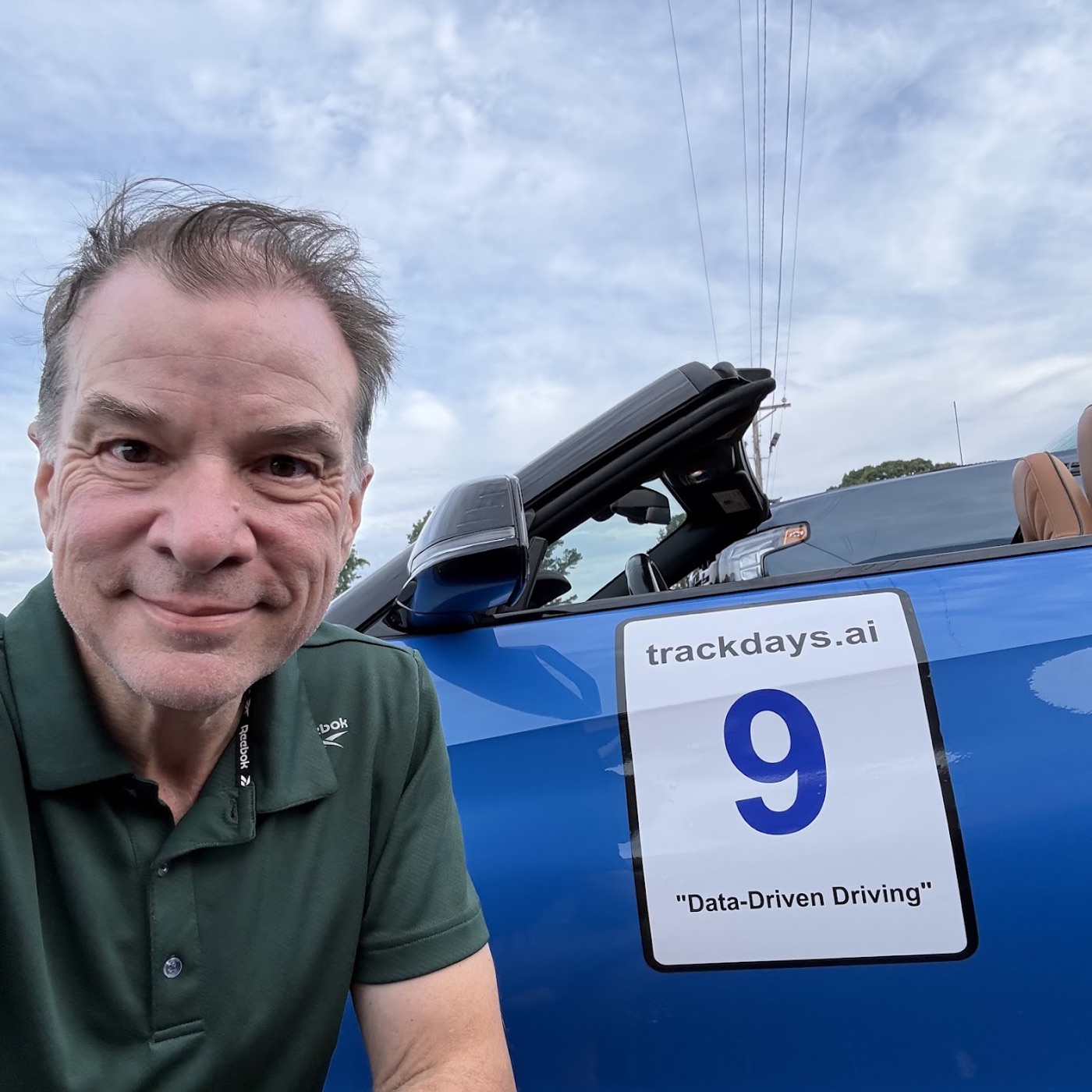 Your ghost's driver, entirely too pleased about all of this. Come take a
lap time off him.
Your ghost's driver, entirely too pleased about all of this. Come take a
lap time off him.
Or bring your own track: if we've both got dense data at the same place, we can race. Email your export — attachment, zip, or even just a Dropbox link — to upload@trackdays.ai. Rich already took a lap time off one of my cars, in a Mini, and got a blog post out of it. The line forms behind him.
Want your laps analyzed like this even without racing me? Same address — Harry's LapTimer .hlptrl, or CSVs from Porsche PTPA, AiM Race Studio, RaceBox — to upload@trackdays.ai. Ask Rich how easy it is; he's driver number seven.